Thursday, 28 February 2013

February 2013

With my workload significantly increasing this term and the deadline for my final media project getting ever closer, I thought it best that I had better get down to filming. So early on the 1st I made the journey up to the Cairngorms and began filming in the adverse weather conditions. It was pretty much a white-out on top Cairngorm but I nonetheless found 20+ Ptarmigan. I got a little footage but my camera was seriously struggling so I descended again. Snow Buntings in the car park peaked at 15. The remainder of the day was spent at Loch Garten RSPB with Crested Tits regularly visiting the feeders.

The following day I was more optimistic, the wind was just as strong but the weather forecast seemed better; perhaps I was in for a better chance filming the Ptarmigan. I had arranged an interview with the Ranger first thing and whilst that was in full swing everything started to go wrong. Firstly my microphone wasn't working and then I noticed my phone ringing: Dan Pointon. That only means one thing; MEGA!

Once the interview had finished I promptly returned the call; there was a bloody Pine Grosbeak on Shetland. There was only ever going to be one outcome here, I went to the hostel, changed my dates and made a casual drive to Aberdeen for the over night ferry. Surprisingly there were only three other birders on the ferry so we decided to team up and share a hire car. The next morning we raced to Collafirth shortly after first light and connected immediately! The brute was munching away on pine needles less than 10ft away offering superb views, and even occasionally flew down to the ground less than 4ft from where I was standing to drink. It eventually got light enough to take some decent photos. We spent over two hours enjoying this beast before heading off in pursuit of gulls.

At East Voe of Scalloway we quickly located the first-winter Ring-billed Gull as it came to bread, and two Iceland Gulls (a first-winter and adult) sheltering from the wind in a sheep field. A Black Guillemot was in the harbour there. The remainder of the day was spent trying to find something new without success; but who could complain?!
I caught the overnight ferry back to Aberdeen and headed straight back into the Cairngorms to continue filming. The weather hadn't changed and I struggled to get any other decent footage of my target species so I'll definitely have to return in March. In the meantime I hit the forests and connected with all the expected specialities (including Capercaillie and Crossbills) but failed with Golden Eagle.

A week later and I had an assignment due but managed to wangle some free time to go to Ireland for the day. Unfortunately myself and Stuart Piner failed miserably to see the adult drake Baikal Teal at Tacumshin Lake (Co. Wexford) despite searching the area thoroughly. Nonetheless there was a nice selection of birds present including the juvenile female Northern Harrier frequently hunting the marsh.

Once the assignment was done and dusted, I went back south to surprise Emma for valentines (who said romance was dead?). There were a few things I wanted to see whilst back in the south so headed off to East Sussex with Lee Fuller for the residing adult winter Bonaparte's Gull (16th). It wasn't showing as well as I had hoped for photography but I still couldn't really complain. On the way home we stopped at Goring for the Snow Bunting and then finally Emsworth for the resident Spotted Redshank; both were far more obliging.  And the Great Grey Shrike finally gave itself up at Beaulieau Road Station (17th) with presumably the same male Hen Harrier quartering the heath.
Being February I really didn't expect there to be much else going on on the birding front this month. I was given some work for the week whilst in Hampshire; very handy I thought, that was until the drake Harlequin Duck on the Outer Hebrides broke. Bugger. If I was in Carlisle I would've left for this bird immediately but in this case I had to wait till the weekend. It was a long week but the bird lingered on so myself, Kev Hale, David Campbell and Gordon Beck made the overnight journey to the Isle of Skye to catch the ferry to North Uist. Whilst at Uig we were treated to fantastic aerial displays from a White-tailed Eagle giving two Golden Eagles some serious grief for at least thirty minutes!

Once on North Uist we dashed to Balranald RSPB where we promptly located the Harlequin Duck diving and preening near off shore rocks. A truly stunning bird to stay the least, even if it wasn't quite in full adult plumage just yet. Unfortunately my photos of the bird simply don't do it justice! Also on the same beach was a flighty 1st winter Glaucous Gull, 20+ Purple Sandpiper, 200+ Linnet and Twite with what looked like a Greenland-type Redpoll amongst them briefly before the flock were flushed by a hunting Merlin.
There was also a rather convenient supporting cast on the nearby reserve with a Richardson's Canada Goose amongst the 1000+ Barnacle Geese, a female Ring-necked Duck amongst the Tufties and two white-morph Lesser Snow Geese loosely associating with Greylags; all of which contributed to an even more memorable trip!
Once home (Southampton) and recovered I had two days spare before making the journey back to Carlisle yet again. I managed a little birding with a White-fronted Goose at Tundry Pond (24th) but failed with a drake Ferruginous Duck at Blashford Lakes (25th), although a very showy Bittern made up for that! Now with this month quickly coming to an end - I hope things are going to quieten down a little to let me concentrate on my assignments.

Thursday, 31 January 2013

January 2013

A new year starts with another bird race. Not the best we've ever done on January 1st with a number of common species that were still missing by early afternoon. Unfortunately once we had dragged ourselves away from the coast we knew it was pretty much game over and subsequently gave up afterwards. 111 ended up being our total. Most frustrating was a possible Red-necked Grebe off Normandy Marshes that was simply too distant to confidently ID. But as is always the way, once the bird race is over the next few days are typically productive; the Glossy Ibis returned from Stanpit (Dorset) to Bickerley Common (3rd) to join the also returning Great-white Egret. A Black-necked Grebe reappeared on Ibsley Water and the Bittern eventually gave itself up on Ivy Lake; not that any of these species were co-operative during the race. On the opposite side of the county 2 Scaup were at Hayling Oysterbeds with a dozen Black-necked Grebes in the harbour, with a further selection of seabirds off Sandy Point later that morning (4th). Presumably the same Red-breasted Goose I found at Needs Ore last winter returned as an adult to Farlington Marshes with the Brent (also 4th). A male Hen Harrier at Beaulieau Road Station (5th) was nice, as indeed was the suspiciously 'tame' redhead Smew in Romsey (6th). A good day out was had in the north of the county (7th) that yielded a number of scarce county residence; all of which I'll withhold for obvious reasons. The returning Ring-billed Gull was yet again at Walpole Park (9th); the Ibis still at Bickerley Common and Red-breasted Goose again at Farlington (both 10th). By now I had pretty much mopped up every bird species in the county.

On the 12th I ventured out of county to Berkshire with Joe Stockwell, Lee Fuller and Dan Houghton for a look at the Buff-bellied Pipits since access had been once again arranged for Queen Mother Reservoir. Unfortunately no sign on arrival; so we wandered anti-clockwise around the waters taking in the wintering Long-tailed Duck, Slavonian Grebe, Red Kites, Ring-necked Parakeets and Egyptian Geese. We had almost made it back to the sailing club when we simultaneously picked up a Pipit fly-in, over us and over 100 or so other (unknowing) birders and then landed on the reservoir basin about a kilometre back from where had just walked from. We trundled back round to find both Pipits on the basin, but before they became settled the birds were flushed by an over-excited crowd and that was the end of that. I literally managed one shot before they flew off. Five Waxwings were seen briefly on the way home on the Hampshire/Surrey border in Farnborough.
The undoubted highlight for me this month was the Pallas's Warbler at Moor Green Lakes (14th) on the Berkshire/Hampshire border. Originally reported as Yellow-browed Warbler for 10 days prior I hadn't taken too much notice of it but as soon as it became apparent that the identification was wrong I bolted up there. No sign of it on the first afternoon I tried in wintery conditions, but the next morning myself and Mick Fuller eventually connected. It followed a tit/crest flock along the river for a short period, but had otherwise spent the rest of the morning on its own; of course I only needed to see it on the south side of the river, to which it obliged. Admittedly I struggled to pick up the central crown stripe as I was mostly looking up at it, but the bird hovered and preened on one or two occasions revealing the diagnostic yellow rump. Four Jack Snipe were seen nearby that afternoon. Images provided by Alan Lewis.
On 16th Needs Ore continued its good run of wildfowl with a drake Scaup on the Blackwater: the first I have seen here. The patch has also had a drake Mandarin and female Goosander; both of which are noteworthy sightings here. A Short-eared Owl took up residence for a short period, whilst a Merlin was typically more brief. There were two male Black Redstarts down the road at Fawley Power Station (19th) in their usual spot and I had a rather nice redhead Smew on Ivy Lake (20th) that constituted the first I had found in the county.
I departed back to Uni in Cumbria on 21st where birding instantly took a back seat; the usual story. Before the month end I managed one day at Caerlaverock WWT (Dumfries) to film landing Whooper Swans that also yielded a drake Green-winged Teal on the Folly Pond.

Monday, 31 December 2012

December 2012

November's quiet end continued well into December; birding was particularly quiet with the same set of birds from Pennington and Needs Ore evidently still in situ. A total of 15 Waxwings dropped in for a few days just round the corner from where I live in Hedge End, a drake Red-crested Pochard was at Blashford Lakes, an adult Bewick's Swan at Harbridge and another Glossy Ibis had joined the resident Great-white Egret on the flood at Bickerley Common on 8th where it remained throughout the rest of the month.
I was only tempted out of Hampshire once; for an adult drake Falcated Duck of unknown origin at Farmoor Reservoir (Oxon) late on the 9th. It nonetheless provoked the usual speculation; is it or isnt it a wild bird, do Falcated Ducks naturally occur in Britain etc etc but once again we'll never know. The bird itself was unringed and fully winged and its arrival coincided with a mass arrival of dabbling ducks from the continent, it associated with a large flock of Mallard (perhaps not ideal, depends which way you look at it) but it was noticeably wary. It remained at Farmoor on and off for the rest of the week before it disappeared and hasn't been relocated so far this winter. A chilly walk around the north Basin also produced three Scaup and a Slavonian Grebe.
And now as the year comes to a close, it is always nice to reflect on the year as a whole and the many highlights it contained. I won't bore everyone with more monthly summaries but my personal highlight of the year was our university trip to Romania where we were bluff charged by a Brown Bear. And I must say I've never shit myself so much nor experience such an adrenaline rush! I also notched up a number of new birds in Romania and later Greece, but more pleasing were the 16 new species I saw in Britain and Ireland including one or two species that I expected to wait another 20-odd years for; Cream-coloured Courser and Belted Kingfisher. And then there were those that were simply out the blue: like Hartlepool's Western Orphean Warbler, though unfortunately many of the other major birds of 2012 didn't stick around long enough to be twitched (Black Skimmer, Magnolia Warbler, and Eastern Kingbird). In addition to the lifers were a few potential arm chair ticks that may or may not make the grade at some point in the future and a handful of decent county ticks which are always greatfully received when I still spend a large proportion of the year at university in Cumbria.
2013 is looking just as promising with a short spell in the Cairngorms early on to film Ptarmigan and Mountain Hares in their harsh winter environments. Then 10 days in Israel towards the end of March with Dan Pointon, Josh Jones and Will Soar; a trip I am very much looking forward too. I will hopefully be graduating with a first followed by a holiday somewhere in the Mediterranean (yet to be confirmed) with Emma in July to soak up some sun. Then finally kicking off the autumn with some seawatching in Ireland in August and rarity hunting in Shetland in October with Dan Houghton and Lee Fuller.

Tuesday, 6 November 2012

November 2012

With Waxwings arriving in off the North Sea, it didn't take long before the first few turned up in Carlisle just up the road from me. These were the first I had seen all year, but were particularly mobile as I followed them around the Kingstown Industrial Estate on the 1st of the month.

Later that day I headed up to Solway to scan the wintering Barnacles and Golden Plover flocks where respective vagrant Canada Geese and American counterparts had previously been seen. Unfortunately the flocks were too distant at low tide for closer scrutiny but the Great-white Egret was still frequenting the saltmarsh pool at Campfield Marsh and the two regular leucistic Barnacle Geese could easily be picked out at range.
Another visit the next day and a similar story; the geese were even further away, the Great-white Egret was still in situ but the Golden Plover were just about within range to sift through. I estimated the flock to be between 2000-3000 strong, possibly more so it took a good couple of hours before I eventually managed to pick out the more advanced American Golden Plover in Moricombe Bay. This bird is still moulting into winter plumage with a reasonable amount of black still on the breast and belly making it much easier to pick out. Though I think I'll be revisiting next week in the hope the flocks return to the sheep fields by Cardurnock and show considerably better; and maybe I'll be able to pick out the other...
Over the weekend, I once again went east with Tristan and Peter. First stop was Seaburn to call into an unseasonal visitor; a juvenile Bee-eater. A bird you certainly wouldn't expect to see in November with frost on the ground and 2 Waxwings trilling over the top; it was quite a peculiar sight. But still the Bee-eater performed well for us, sitting on aerials and flying low overhead to catch a surprisingly good number of wasps to feed on (though I hope it departs to the south soon, back to the continent and doesn't succumb to an unfortunate fate like others, that have arrived so late in the year).
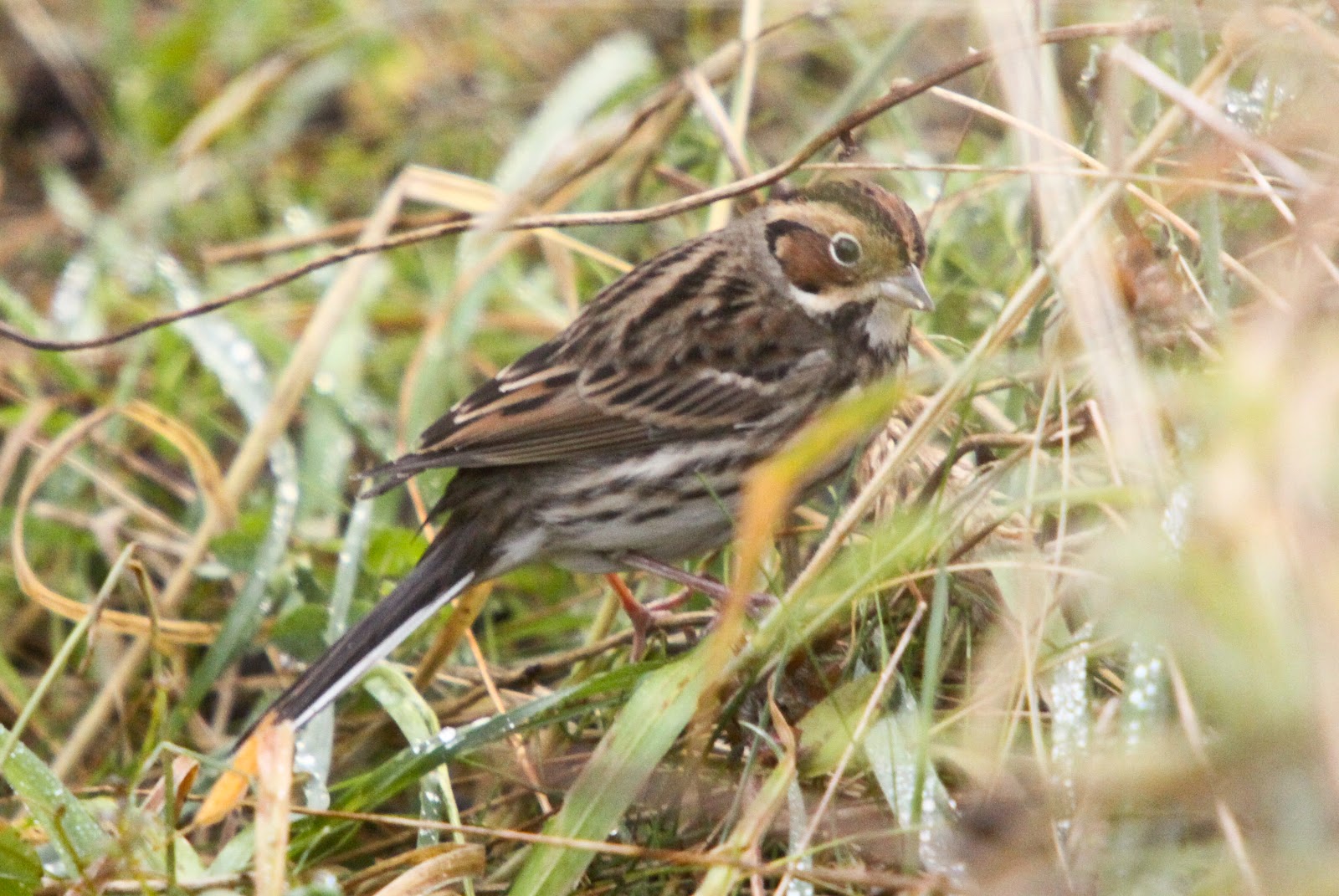
It was quite a leisurely afternoon really, we had lunch at Whitburn followed by a stroll around the ringing plantation. Peter had a Yellow-brow whilst Tristan and I saw very little besides an adult winter Mediterranean Gull up the road. The late afternoon was spent a little further inland at Houghton-Le-Spring. Visibility was poor as the place was shrouded in thick fog but we still spent an hour or so here searching for a Little Bunting. The bird had apparently been frequenting a hawthorn hedge backing onto a sewage works, but was typically elusive and disappeared for hours at a time. Luckily I stumbled upon the bird feeding in long grass just off the beaten track, it continued to feed and approached the small gathered crowd to within 15 feet before flying up into the hedge and lost to view in the fog, 'tick'-ing as it went. It was only the second Little Bunting I have seen and gave much more prolonged and satisfying views than the first.
From this time of the month onwards the weather deteriorated; heavily overcast and rain became an almost constant fixture so another trip up onto the Solway unfortunately didn't materialise before I headed off to the Isle of Mull with Cain Scrimgeour and Ewan Miles to begin filming for my final media project. Again the weather was less than ideal but wind remained calm which meant I could continue filming; the trip was a general success with most the target species to film ticked off including Otter, where we found no fewer than 6 individuals over three days but only 3 allowed us to stalk them to get good footage. Other highlights included a brief Aurora encounter, White-tailed Eagles and a family of Golden Eagles - the juvenile watched reasonably close hunting rabbits was incredible! I also found a Firecrest in the Tobermory car park - it was literally the first bird I clapped eyes on on the island so I was abit blasé when pointing it out to the others. Turns out though its a first for Mull!! We also found a few small groups of Waxwing on the island. I shall add some footage to due course.

Returning to Cumbria from Mull on the 16th, I then headed back south to Hampshire on the 17th with a few detours not far off the motorway to include various birds. First stop was at dawn for the currently resident Lesser Yellowlegs (and Wood Sandpiper) at Aldcliffe Marsh, Lancashire. Nice views in terrible weather, but this is by far the latest Wood Sandpiper I've ever seen in Britain. Next stop was Middleton Lakes in Staffordshire for a 1w White-rumped Sandpiper; the weather had slightly improved but this bird was mostly mobile and distant so again no (respectable) photos. Rather embarrassingly though, this was only my second White-rumped Sand in Britain! Leaving here much later than expected I then had to put my foot down to get to Pagham Harbour (West Sussex) before the light began to go. I must admit I had been playing the Hooded Merganser quite cool having not twitched it from Carlisle - I simply couldn't justify it and then leaving it till last thing on the 17th was perhaps too cool as on arrival there was no sign. Frustratingly it hadn't been seen all afternoon but I began scanning the harbour before over hearing a conversation that the bird had been seen in the NW corner of the harbour. I dashed over there and scanned to no prevail and by now the sun was pretty low in the sky.

About to cut my losses I received an anonymous call to which I wasn't going to answer but luckily did, it was Dave Wallace and he was watching the Merg back by the sluice gates on the North Wall!! I dashed over there as quick as I could - indeed I ran for it and even then only watched it amongst Wigeon for a matter of minutes, diving occasionally before taking off on its own. I watched it in my scope till it was literally a speck in the sky heading in a NW direction - it hasn't been seen since! Judging by the limited white in the wings this bird is probably a first-winter, and also a female by the rather dull eye colour. Males tend to have a pale iris. I'm also quite optimistic about this bird, it appears to have turned up at a decent time of year, fully winged, unringed etc, so hopefully the BBRC will have no problem accepting this bird knowing they've got form for doing so already.
Still playing catch-up in Hampshire I was then down Calshot spit (Hampshire) shortly after first light on the 18th for a long-awaited grounded Richard's Pipit in the county. Nearly all are flyovers from the Pennington/Keyhaven area and Barton-on-sea during the autumn. Surprisingly this bird showed well commuting between the SE corner of the power station and the dog walkers field near the beach huts, before settling at the latter. Later in the morning it was reported to have flown out over The Solent and subsequently hasn't been seen since. A Black-necked Grebe was feeding offshore. The remainder of the month was rather quiet on the birding front where birding was confined to the marshes (Pennington and Needs Ore) with nothing out the ordinary to report besides a Black-throated Diver from the former on the 25th and a Firecrest from the latter on 27th.

Monday, 8 October 2012

October 2012

Since the turn of the month I have moved back up to Carlisle for my final year of University, so I don't intend being back in Hampshire till the christmas break now. Being based in Carlisle during the autumn period is usually quite rewarding putting me in a prime position for twitching any of the Northern or Western Isles. So with this in mind when news of a Swainson's Thrush broke on Barra (Outer Hebrides) I was initially enthusiastic to go. But after speaking to various mates I decided not to go since the species is almost annual nowadays. The following day the bird was still there and apparently showing well, but I had a lecture that I didn't want to miss so the answer was still no. The next thing I know that lecture had been cancelled and I've got five days spare!

At that point I simply decided I wanted to go to fill up my time despite getting the feeling that it was going to be an unsuccessful trip. We left during the early hours of the 4th and caught the ferry from Oban to Castlebay - via Coll and Tiree. The highlights were about a dozen Harbour Porpoise, Black Guillemots and two amazing adult White-tailed Eagles fishing successfully in the Sound of Mull. Though we still had no news of whether the Swainson's was actually still there...

On arrival at 15:00 we dashed to the Northbay Hotel, only to be greeted with a letter addressed to us that the bird had relocated. Interestingly 3 miles to the south to Brevig (coincidentally the 2010 Hermit Thrush did a similar thing), so off we went to Brevig. Once there we found out the Swainson's had only been seen for a matter of seconds in the early afternoon and not again since. Our hearts sunk, this was probably the most vegetated place on the island and knowing how skulky these birds can be; knew it would take something special for us to see it!

Our luck was really in with this one when a ringer then appeared pointing to a bag in his other hand. He had only gone and caught the Swainson's Thrush in a mist net running through one of the adjacent gardens and therefore treated us to close-up in hand views!! After being processed it was released into another sparcely vegetated garden where it simply skulked, before flying to another bush and remained mostly out of view until we left. Meanwhile two Golden Eagles soared overhead. The Swainson's had a fat score of zero so the outcome of this bird is anybodies guess.
We spent the night on South Uist, ready to depart from Lochmaddy (North Uist) at midday; the highlights were a couple of Black-throated Divers in the Sound of Barra, Common Redpoll in a garden at Bornish, and an eclipse drake American Wigeon on Loch Bee with 20+ Greenland White-fronted Geese. Two more adult White-tailed Eagles also flew past us in Lochmaddy with yet another in Uig (Isle of Skye). Big news of the day concerned the remarkable news of an Eastern Kingbird found on Inishmore (County Galway; Ireland), a first for the Western Palearctic that I simply had to go for!! Unfortunately I was probably in one of the worst places possible but still had an outside chance of getting there the following morning...

We drove non-stop for 10 hours to Holyhead where I teamed up with Fred Fearn, Pete Antrobus and John Gregory. The trip ran surprisingly smoothly; we caught the 02:30 ferry to Dublin and drove to Rossaveal (Co. Galway) in good time ready to catch our connecting ferry to Inishmore at 10:30. Unfortunately news had filtered out the Kingbird had gone. Gutted!! Then things got manic; a Belted Kingfisher was found near Letterfrack and a Myrtle Warbler on the same island the Kingbird was. I hadnt seen either, but knew immediately which bird I was prioritising. We dashed up to Letterfrack but had no idea where the Kingfisher actually was; no maps and no signal we just drove around aimlessly trying to locate likely places without success until one of us managed to get a signal and phoned Alan Lewis; who we knew was watching the bird!! Thankfully we were close and were there watching this amazing beast within five minutes! This was without doubt the best compensation I have ever had from dipping another bird, and I have always wanted to see one since missing the touring 2005 bird!
Logistically I couldn't make either of the Myrtle Warblers (by that time there was apparently two) on Inishmore so we went to Slyne Head to see what we could find. The answer was not alot so we headed back to Dublin for our ferry.

The week leading up to my birthday was pretty unproductive with casual local birding, and I spent my birthday (12th) marching back and forth on top a quarry in Durham trying to see a Pallas's Grasshopper Warbler. Another waste of time, but I did see a Locustella sp twice, once inflight, the second moving quickly through the low branches of a young pine but too quick to focus and get a decent view. One that got away; though it was good to see that things were on the move again with small numbers of winter thrushes arriving in off the sea.

So on the 13th I headed back East with Tristan and Chris to hit some of the regular sites in search of some migrants, first up was Newbiggin where we checked the bushes surrounding the Ash Lagoon. Nothing spectacular but good numbers of Goldcrests and Robin and the occasional Brambling passing overhead. A Paddyfield Warbler was then reported from St. Mary's Island just down the coast, so as Chris needed this for a British tick we immediately headed back to the car. On arrival the warbler was showing well as it sat out in the open sunning itself in willows around the dipping pond and I instantly took to the camera to grab some record shots, once I had a few I then had a proper look through the bins and realised instantly that the bird we were watching was not a Paddyfield! Initially I was stumped, the bird had quite a limited supercilium, no way near as prominent as Paddyfield, no rufous tones, seemed uniform brown all over, plain tertials and a short clustered primary projection. The bill was also spikey and so after a quick discussion we decided that all the features seemed to point towards a Blyth's Reed. We saw the bird again several times after once it had adopted a more typical behaviour; it became very skulky but showed its classic banana-like posture that it usually associated with the species. Unfortunately we did not hear it call.
The same bushes also held a vocal Yellow-browed Warbler and just across the way was a Red-breasted Flycatcher and another Yellow-browed called (though this may have been the same bird). Once we had had our fill we continued down the coast to Tynemouth where there was again lots of common migrants (mainly the same mix of stuff we had seen at Newbiggin) with the addition of a Yellow-browed Warbler tagging onto the end of a large Tit flock moving around the car park.

Impressed with the day, I went back the next (14th) with Colin Lister but there had unfortunately been a total clear out with nothing really noteworthy seen, although a band of rain in off the North Sea about midday dropped a load of Goldcrests and Robins, but that was it for us. It must have deposited more though as there was a Pied Wheatear new in just up the coast at Holy Island and an Eastern Olivaceous Warbler in Fife. We didn't have time to see neither that day.

Eastern Olivaceous Warbler was a bird I thought I'd eventually see on Portland so had been waiting for a close one for quite a few years. Fife Ness was only 2.5 hours away from me in Carlisle so I decided straight away that I'd head up for this bird in the morning (15th). It was an early start - meeting with Mick Frosdick and arriving at Fife Ness before dawn. There were migrants everywhere, prodominantly finches and thrushes; all of which on the move in the clear conditions. Two Yellow-browed Warblers were found around the car park whilst we waited for the sun to get high enough in the sky to light up the rose bushes behind the ruined toilet block. As soon as it had the Olivaceous began to 'tjack' and before long the bird was giving fantastic views. This was another educational bird; olive-grey upperparts, grey legs but the primary projection didn't seem all that short, neither long. White outer feathers to the tail that the bird frequently pumped downwards as it 'tjeck'ed regularly. The bill was long and pointed, yellow-orange lower mandible that was very wide at the base ruling out other similar species! Later that day I headed south back to Southampton to work for a week.
Thankfully nothing good broke that week whilst I was busy till the weekend when a Siberian Stonechat was at Birling Gap (East Sussex). I went Sunday 21st with Lee Fuller, we instantly connected with the bird from the car as we drove past. The bird was chased back and forth along the road but the best line of attack was to just sit in your car with the windows down and wait for it to come your way. In the end I drove right up to it and we papped the first winter male from the car; for a bird I always thought was quite a dross species, I must admit I was pleasantly surprised and it exceeded expectations by far, this was a stunner of a bird. Another stunner was the juvenile Sabine's Gull we saw on the way home along Brighton Promenade that literally walked between residents and flew low over peoples heads. Absolutely incredible! The final highlight of the day was the regular french ringed Great-white Egret back along the Avon Valley (Hampshire) at Bickerley Common on the flood.
BOOM!! The head gasket went on my car on the way home...and I was stranded down in Southampton for a few more days whilst it was fixed. It couldn't have happened at a worse time. I had absolutely no way of getting up to Uni for my lecture and assignment hand-in and no way of getting to Shetland for Britains second ever Chestnut-eared Bunting and was left pocketless. Oh well...theres been two now...and three in the WP since 2004 so I'll give it less than 10 years before the next...
Three days later I got my car back and headed straight to Portland (Dorset) to do some uni work. It just so happened there was an adult male Daurian Shrike there the day before. There were birds everywhere on Portland; again mostly a mixture of finches and thrushes but there was no sign of the Shrike during the morning but a Siberian Stonechat had been found up at Culverwell so off I went. But as it turned out I ended up seeing the Daurian Shrike before the Stonechat. Both of which mobile in the windy conditions so I only managed to obtain a few record shots with my phone. The Stonechat was noticeably different to the one I saw the weekend before. The light could easily change the colour of this and although pale in its overall appearance the underparts were strikingly bright and the rump cleanly unmarked but again peachier in colour. It has since been suggested this bird may be of the form 'stejnegeri', and shortly after trapped and ringed so I'm sure its not the end we'll hear of this bird...
The final few days of the month were spent in Worcestershire with Emma and her family for their annual autumnal holiday.  I took a few detours enroute to take in the drake Lesser Scaup in Villice Bay, Chew Valley Lake and Long-billed Dowitcher at Slimbridge WWT which were nice. We also discovered something else sharing the house with us: